Skip to content
Skip to SEARCH-3
Skip to ARCHIVES-3
Skip to LINKS-4
Skip to LINKS-3
Skip to RECENT-COMMENTS-4
Providing information on the most underrated of amniotes: the reptiles

THE REPTIPAGETHE REPTIPAGE

Providing information on the most underrated of amniotes: the reptiles

Shrunk Expand

Primary Navigation

  • Home
  • Contact
  • Archives of the DML
  • Tag Archives pterosaurs
  • Everything Wrong with Prehistoric Planet: Islands

    Posted on 25 November, 2025 15:01 by Jura 2 Comments

    For a primer on this blog series and an FAQ see here.

    Other Episodes
    Coasts Deserts Freshwater Ice Worlds Forests
    Islands Badlands Swamps Oceans North America

    This episode features contributions from the following paleontology consultants:

    • Steve Brusatte
    • John Conway
    • Alexander Farnsworth
    • Scott Hartman
    • Robert Spicer
    • Paul Valdes
    • Mark Witton
    • Darren Naish

    This episode is focused on island (or potential island) life of the Maastrichtian.

    Continue reading → Post ID 34317


    This entry was posted in Dinosaurs Extinct Reptiles Pterosaurs Uncategorized and tagged dinosaurs Hatzegopteryx Majungasaurus Prehistoric Planet pterosaurs scientific accuracy Simosuchus
  • Everything Wrong with Prehistoric Planet: Freshwater

    Posted on 17 May, 2025 20:13 by Jura 1 Comment

    For a primer on this blog series and an FAQ, see here.

    Other Episodes
    Coasts Deserts Freshwater Ice Worlds Forests
    Islands Badlands Swamps Oceans North America

    This episode features advisement by the following paleontology consultants:

    • Steve Brusatte
    • Alexander Farnsworth
    • Scott Hartman
    • John Hutchinson
    • Robert Spicer
    • Paul Valdes
    • Mark Witton
    • Darren Naish

    Continue reading → Post ID 34317


    This entry was posted in Dinosaurs Extinct Reptiles Pterosaurs Sauropterygia Uncategorized and tagged beelzebufo Deinocheirus dinosaurs documentary Masiakasaurus plesiosaur Prehistoric Planet pterosaurs scientific accuracy Velociraptor
  • Everything Wrong with Prehistoric Planet: Coasts

    Posted on 8 March, 2025 0:19 by Jura 4 Comments

    For a primer on this blog series and an FAQ, see here.

    Other Episodes
    Coasts Deserts Freshwater Ice Worlds Forests
    Islands Badlands Swamps Oceans North America


    This episode features advisement by the following paleontology consultants:

    • Steve Brusatte
    • Alexander Farnsworth
    • Kiersten Formoso
    • Michael Habib
    • Scott Hartman
    • John Hutchinson
    • Luke Muscutt
    • Peter Skelton
    • Robert Spicer
    • Paul Valdes
    • Mark Witton
    • Darren Naish

    Continue reading → Post ID 34317


    This entry was posted in Dinosaurs Extinct Reptiles Pterosaurs Sauropterygia Uncategorized and tagged dinosaurs documentary mosasaur plesiosaur Prehistoric Planet pterosaurs scientific accuracy
  • Were pterosaurs naked after all?

    Posted on 5 July, 2021 21:30 by Jura 5 Comments
    Dueling interpretations of the pterosaur, Coloborhynchus clavirostris. Image by Megan Jacobs

    Although 2020 was an all around shit show for the world, there were a few interesting bits of paleontology. Perhaps none more interesting than this potential overhaul to pterosaur reconstructions. Now, I haven’t really written anything about pterosaurs on my site yet (aside from some basic rundowns of news stories), so this marks an interesting way of christening the occasion. Pterosaurs are a fascinating group of critters that showcase yet another example of how animals can get airborne. They are also enigmatic in their origin and evolution.

    One thing that we seemed to be confident about for a long time now is that pterosaurs had fuzz. It wasn’t fur in the mammal sense, and it sure as hell wasn’t feathers (more on that in a minute), but instead a third (or fifth, when counting arthropods and some plants) form of insulative covering. At least, that’s what I thought we knew up until about last year.

    It may just turn out that this seemingly rock-solid interpretation of pterosaur outer coverings has been wrong all along.

    Continue reading → Post ID 34317


    This entry was posted in Extinct Reptiles Pterosaurs Uncategorized and tagged actinofibril aktinofibril feathers glabrous skin integument protofeathers pterosaur pterosaurs pycnofibre scales
  • New paper on the strangest pterosaur ever.

    Posted on 2 March, 2008 23:40 by Jura Comment

    Ooh, I’m coming in under the wire this time (see the time stamp).

    So when someone talks about pterosaurs, or flying reptiles, you probably think of something like one of these:

    PteranodonRhamphorhynchus

    Pteranodon and Rhamphorhynchus. The two archetypes of pop culture pterosaurs.
    Former image from here. Latter image by Charlie McGrady.


    Few folks would normally think of this as a normal pterosaur:
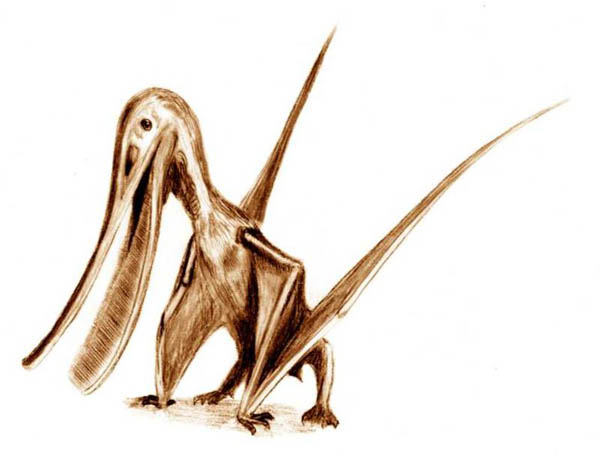
    Pterodaustro

    Pterodaustro guinazui (pic culled from Wikipedian artist: Arthur Weasley).


    Its name was Pterodaustro guinazui, and unlike other pterosaurs, which fed on fish, insects, or other types of meat, P. guinazui was a filter feeder. It has commonly been compared to a Mesozoic flamingo (thus resulting in more than a fair share of flamingo like drawings). It sifted microorganisms from the waters that it lived near. Unlike today’s modern flamingo (Phoenicopterus), Pterodaustro could filter feed without dipping its head upside down. As far as pterosaurs go, it was certainly one of (if not) the strangest species to have come from this group.As is typical with the weird ones, though they are celebrated for their uniqueness; that is about all that is known about them.

    Well, no more:

    Chinsamy, A., Codorni?, L., Chiappe, L. 2008. Developmental growth patterns of the filter-feeder pterosaur, Pterodaustro guinazui. Biology Letters. DOI: 10.1098/rsbl.2008.0004 (online: first cite)

    Abstract
    Life-history parameters of pterosaurs such as growth and ontogenetic development represent an enigma. This aspect of pterosaur biology has remained perplexing because few pterosaur taxa are represented by complete ontogenetic series. Of these, Pterodaustro is unique in that besides being represented by hundreds of individuals with wing spans ranging from 0.3 to 2.5m, it includes an embryo within an egg. Here we present a comprehensive osteohistological assessment of multiple skeletal elements of a range of ontogenetic sizes of Pterodaustro, and we provide unparalleled insight into its growth dynamics. We show that, upon hatching, Pterodaustro juveniles grew rapidly for approximately 2 years until they reached approximately 53% of their mature body size, whereupon they attained sexual maturity. Thereafter, growth continued for at least another 3–4 years at comparatively slower rates until larger adult body sizes were attained. Our analysis further provides definitive evidence that Pterodaustro had a determinate growth strategy.

    Pterodaustro skull

    Pterodaustro guinazui skull (photo from: http://www.pterosaurier.de)


    I have yet to read the full paper, but from what it says here, it would appear that the filter feeding lifestyle took its toll on P. guinazui, as its growth rate was remarkably slow. As this is the first time a growth series has been done on a pterosaur, it probably shouldn’t be assumed that this growth was typical of all pterosaurs (which would have had diets that were much higher in protein, thus aiding growth). Still the results are definitely interesting. Plus any new bits of info on the world’s strangest pterosaur, is a good thing in my book.

    ~Jura


    This entry was posted in Uncategorized and tagged filter feeder filter feeding flying reptile pteranodon Pterodaustro Pterodaustro gui?azui pterosaurs reptile Rhamphorhynchus
  • The Hummingbird of Pterosaurs.

    Posted on 11 February, 2008 20:33 by Jura Comment

    Nemicolopterus

    Just announced today in the journal PNAS, is the discovery of the world’s smallest pterosaur. Dubbed: Nemicolopterus crypticus, this little guy had a wingspan of only 10 inches (25.4 cm). I haven’t had a chance to read the paper on it yet, but from the abstract, it appears to be a juvenile. I’d like to know how much larger the authours believe N.crypticus got.

    Either way, this is big news for pterosaur researchers. It means that either:

    • A.) Pterosaurs covered a greater size range than previously thought, or…
    • B.) Pterosaur juveniles lived in different niches than adults.

    Given the reptilian status of pterosaurs, I wouldn’t be surprised if it did turn out to be choice B. The large size discrepancy between adults and hatchlings / juveniles, often results in the formation of two size classes per species. This allows the animals to better exploit their given ecosystems.

    Anyway, we’ll just have to wait for the paper, and see what the results suggest.

    Still, it’s a mighty neat find.

    ~Jura


    This entry was posted in Uncategorized and tagged Nemicolopterus crypticus paleontology. pterosaurs reptiles smallest pterosaur

  • Recent Comments

    • JuraJura on Everything Wrong with Prehistoric Planet: Islands
    • Zach VarmitechZach Varmitech on Everything Wrong with Prehistoric Planet: Islands
    • JacksonJackson on The return of the scaly T. rex to modern paleo-art
    • JamesJames on Everything wrong with Prehistoric Planet: FAQ
    • Brandon S. PilcherBrandon S. Pilcher on Everything Wrong with Prehistoric Planet: Freshwater
  • Archives

    • December 2025
    • November 2025
    • July 2025
    • June 2025
    • May 2025
    • March 2025
    • December 2024
    • April 2023
    • June 2022
    • April 2022
    • December 2021
    • July 2021
    • February 2020
    • August 2019
    • July 2019
    • July 2017
    • June 2017
    • March 2017
    • August 2016
    • May 2016
    • January 2016
    • June 2015
    • May 2015
    • August 2014
    • July 2014
    • June 2014
    • April 2014
    • July 2012
    • January 2012
    • August 2011
    • April 2011
    • January 2011
    • November 2010
    • August 2010
    • June 2010
    • February 2010
    • January 2010
    • December 2009
    • October 2009
    • September 2009
    • July 2009
    • May 2009
    • April 2009
    • March 2009
    • February 2009
    • January 2009
    • October 2008
    • September 2008
    • August 2008
    • July 2008
    • June 2008
    • April 2008
    • March 2008
    • February 2008
    • January 2008
    • December 2007
    • November 2007
    • September 2007
    • August 2007
    • July 2007
    • March 2007
    • February 2007
    • January 2007
  • The Reptile Pages

    • Bio of the Author
    • Dead Reptiles
    • How to Use the Site
    • Living Reptiles
    • Photo Credits
    • Reptiles Home
  • Blogroll

    • Catalogue of Organisms
    • Crurotarsi: The Forgotten Archosaurs
    • Paleo Errata
    • Pick & Scalpel
    • Tetrapod Zoology
    • Why I Hate Theropods

©2025 Raindrops Child Entries RSS and Comments RSS Child theme Raindrops Child of Raindrops Theme