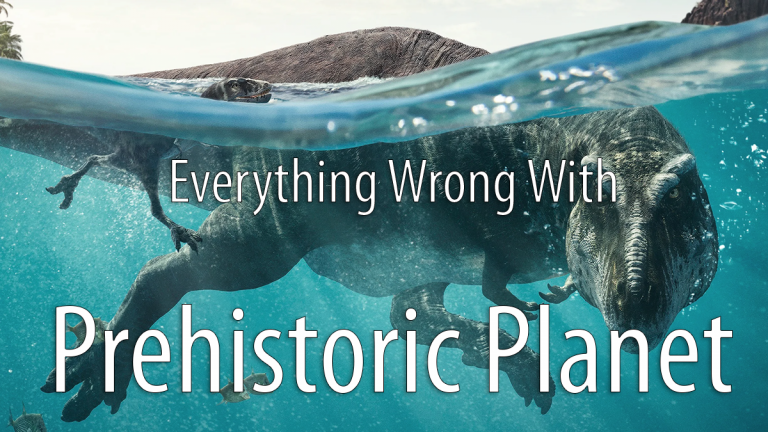
This has been an idea that I toyed around with ever since the original marketing push for the show. It was clear to me then that the show was going to portray a very distinct narrative regarding dinosaur paleobiology and paleoecology. When the series originally came out I watched it, took my notes and then sat on it. I did this in part because I knew that most people would view the criticism as petty whining or complaints about dinosaurs not looking the way that “I” think they should, or any of the other complaints I received the last time I shot down these “documentaries”. So I let it go.
The first season of Prehistoric Planet came and went with a bunch of fanfare from the paleophile crowd but very little movement on the pop culture barometer (being shackled to Apple TV really limits the reach of the series). No harm no foul. Except that to date no one has really tackled the myriad problems with the show’s factual accuracy. As far as internet history is concerned, Prehistoric Planet is a resounding success for paleontology and science communication.
Then “season 2” came out to a similar amount of hype. I was intending to release this post during then but sat on it again. This time was because I got too busy IRL. Now, here we are some two years after the original came out and with us on the cusp of a new Walking with Dinosaurs series, I’m finally publishing this.
This post is the first of an 11-part series done in the style of the CinemaSins YouTube series. Each installment covers an episode. This installment covers the Freqently Asked Questions about the blog series with the goal of cutting off some of the most common questions before I (inevitably) see them in the comments.
Digestive efficiency is one of those reptile misconceptions that makes the rounds every now and again. It’s not as pervasive as the “lack of aerobic capacity” or “inability to maintain body temperature” arguments, but there is still a general view in many scientific circles (*cough* paleontology *cough*) that reptiles are less efficient at digesting food than similar sized mammals and birds. Much of this boils down to the old endothermocentric fallacy that the high costs associated with obligate endothermy should somehow translate to greater benefits everywhere else (Greenberg 1980).
Well that, and the fact that reptile chewing is very different from mammalian chewing.
In the past few weeks we have seen the introduction of two major additions to dinosaur media. Both come from well-established franchises, but only one of these is getting lambasted by the online paleo community. Why is that?
More specifically, why has Jurassic World: Dominion received a mix of resignation and revulsion whereas Prehistoric Planet has garnered near universal praise.
The following is a quick review for the new book by J. Sean Doody, Vladimir Dinets, and Gordon M. Burghardt. The book came out last year and I feel like it received relatively little fanfare in the paleo and herpetological circles (though I did come across one review from the British Herpetological Society, as well as this podcast interview with Sean Doody).
The TL;DR version of this post is as follows: The Secret Social Lives of Reptiles is a landmark piece of literature that should become a foundational reference for any future study looking at reptile behaviour. The authors firmly describes where we currently are in reptile social behaviour studies, and just how much further we can still go. It’s a must read for any budding herpetologist, and a highly recommended read for herpetoculturalists / reptile fans. The best part of the book is its extensive bibliography, which offers a strong launching point for anyone interested in studying reptile behaviour. If you study any aspect of reptiles as organisms, then this book deserves a spot on your shelf.
So, go out and get it.
For more specifics about the book, feel free to read on from here.
In the field of vertebrate paleontology and associated paleophilia, the Dinosaur Mailing List (DML) was an invaluable source of information and networking opportunities. For many—including myself—the DML was a formative experience.
Started back in late 1993/1994 at the University of Pennsylvania, the list initially ran internally with individuals on the list exchanging e-mails back and forth. Then, a few months later, the Cleveland Museum of Natural History agreed to host an archive of these e-mails, creating the now venerable Dinosaur Mailing List Archive. In its heyday, the DML would readily see an influx of more than 100 e-mails a day, covering everything from pack-hunting in theropods to the latest buzz on yet to be published fossils.
Sadly, over the years and with the rise of social media, the list has fallen into disarray with fewer practicing paleontologists (and people in general) using it. As of this writing the DML sees a handful (1–5) e-mails a day with almost all of them being links to recently released papers and associated news articles (courtesy of the ever diligent Ben Creisler). While the present version of the list is but a shell of its former self it is the immense history of the archive that matters. 27 years of correspondence from various paleontologists throwing around ideas and challenging hypotheses. More than just offering a fascinating glimpse into the past, the DML archive has proven influential enough to even get cited in publication (e.g., Witton and Habib 2010).
Unfortunately, earlier this year the Dinosaur Mailing List suddenly disappeared from its former location (dml.cmnh.org). Their host, the Cleveland Museum of Natural History, could no longer afford to maintain the archive on the site, forcing it to shut down. DML owner and listserv moderator, Mickey Rowe, attempted to find another host but to no avail. Thus, in late summer 2021 the DML archive officially disappeared from the internet.
Thankfully, through diligent efforts from Nick Gardner and others, a copy of the archive, prior to shutdown, was obtained from Rowe and distributed freely to anyone willing to host the archives. The hope is that with enough redundant backups out there the archive should never disappear again.
So, I’m doing my part. The DML Archives from April 1994 to May 2021 can now be accessed on the Reptipage.
You will also find a menu link at the top of the blog.
We are still waiting to see where the new archive of the DML will land (for now, no e-mails are being archived). Hopefully, the DML will continue to find a home somewhere. If not, and this is the end of an era, this mirror will be one of the many headstones for this once illustrious interaction of amateurs and professionals.
Major Update: The University of Southern California has picked up the mantle and started archiving new messages from the DML.
However, one must be a member of the Dinosaur Mailing List to access the archive.
Thanks to Mary Kirkaldy and Ben Creisler for the following information on how to properly get access to the new DML archive (see instructions below).
To join the DML, you will first need to send a message to sympa@mymaillists.usc.edu from the address that you want to use to subscribe to the list.
In the subject line, put: subscribe dinosaur-l First Name Last Name.
Change “First Name Last Name” to your name or the name you want to use.
Subscription is free.
The next step is to access information about your subscription to the dinosaur mailing list. Go to: https://mymaillists.usc.edu/sympa
The first time you visit the site, click on: “First login?” at the upper left of the page.
Enter your e-mail address and click the “Request first password” button. The site will e-mail you a message with a link.
Clicking that link will take you back to the site with a page asking you to enter a password twice.
Once you are logged in, any lists you are subscribed to will appear in a pane on the left. Click on “dinosaur-l” to access your subscription options.
You can also type “dinosaur” in the Search List on the left. It should bring up the DML main page. From there, click on Archive on the left. It should open and allow you to choose a month.
If you would like to learn about your subscription options and how to change them, click the “help” tab near the top right. If you are set to digest mode, note that it is in MIME format for the digests. There is an option for plain text if you don’t like the MIME format. The list is configured to send out a reminder once every two months.
This isn’t as easily accessed as it was in the past, but it’s a heck of a lot better than no archiving at all.
Dueling interpretations of the pterosaur, Coloborhynchus clavirostris. Image by Megan Jacobs
Although 2020 was an all around shit show for the world, there were a few interesting bits of paleontology. Perhaps none more interesting than this potential overhaul to pterosaur reconstructions. Now, I haven’t really written anything about pterosaurs on my site yet (aside from some basic rundowns of news stories), so this marks an interesting way of christening the occasion. Pterosaurs are a fascinating group of critters that showcase yet another example of how animals can get airborne. They are also enigmatic in their origin and evolution.
One thing that we seemed to be confident about for a long time now is that pterosaurs had fuzz. It wasn’t fur in the mammal sense, and it sure as hell wasn’t feathers (more on that in a minute), but instead a third (or fifth, when counting arthropods and some plants) form of insulative covering. At least, that’s what I thought we knew up until about last year.
It may just turn out that this seemingly rock-solid interpretation of pterosaur outer coverings has been wrong all along.
The paper makes some pretty hefty claims regarding dinosaur metabolism, and as such, has received a fairshare of media coverage touting this as the latest evidence for “warm-blooded” (i.e., automatic endothermic) dinosaurs.
Every time there is a major headline like that, I feel obliged to go back to the source to see what the media has likely overblown. In this case, media claims don’t seem that far off what was written in the actual paper, which is not necessarily good. Some of these claims do extend beyond the reach of the available evidence (e.g., there actually is no comparison with other contemporaneous reptiles of the region, weakening any arguments for metabolic thermoregulation).
It’s been an age since I’ve done one of these paper breakdowns, but I think this one warrants a more thorough analysis, especially given the implications of the interpretations.
The latest edition of Peter Uetz’s Reptile Database has just been released, adding 80 new species to the group, pushing Reptilia over 11,000 species strong. Along with this comes the phenomenal realization that Reptilia may actually be the most speciose group of tetrapods alive today.
As Uetz wrote on his update:
According to eBird, there are 10,721 bird species worldwide although these numbers vary depending on the source (see global bird checklists available from Avibase). Based on that, there are now more reptile species than bird species.
That is pretty huge. As I mentioned some five years ago, Reptilia has traditionally been viewed as being more speciose than mammals, but still way below birds. These new results suggests that reptile species are at least on par with those of birds, if not beyond them. Interestingly, this time around much of that increase in species was due to new discoveries, rather than the elevation of subspecies. There are still so many new species to discover in this group.
According to Uetz:
However, birds still have way more subspecies than reptiles, namely 17,991 subspecies of birds while reptiles have only 2,310 subspecies (or 3,304 if you include nominate subspecies). In general, ornithologists seem to like subspecies more than herpetologists, so there appear to be cultural preferences at play.
This is definitely a change of pace from previous decades where lumping and a reluctance to nominate new species, kept reptilian species counts way down. It appears that many of the lumpers from previous eras, have since been replaced in herpetology, or they moved over to ornithology. Which is not to say that there’s still not a problem with lumping in herpetology.
An exact breakdown of species by higher taxonomic level is currently unavailable, but a comparison to the data from July 2018, with data from my last entry on this is still plenty telling:
Amphisbaenia = 196 (+8)
Lacertilia = 6512 (+525)
Serpentes = 3709 (+213)
Chelonia = 351 (+10)
Crocodylia = 24 (-1)
Sphenodontia = 1 (+0)
Without a doubt, Squamata is the reason for this huge increase in year-by-year numbers. This is not that surprising given that Squamata has always been viewed as the most speciose group of reptiles. The small size of many squamates makes them easy to overlook, whereas the large size of most turtles and all crocodylians, makes them relatively easy to find (that said, expect Crocodylia to surge up by at least three species in the near future). Even within Squamata, lizard species outpace snakes nearly two-fold in both total described species and new species discovered. Again, the larger size of snakes relative to lizards is likely responsible for this. Smaller animals just tend to get more overlooked.
I suspect that as the years go on, we will continue to see Reptilia grow in species number at an accelerated pace compared to mammals and birds. This group has been overlooked for so long, that much of these results are happening because people have finally bothered to start looking. The big question now is when will this accelerated pace start slowing down?