• Category Archives Dinosaurs
  • Dinosaur articles

  • Extinct Reptiles » Dinosaurs
  • The old grey sauropod just ain’t what she used to be.

    Actually, I’ve never thought that sauropods were grey. Mammals in general tend to be rather bland in their colour schemes. Reptiles don’t have that problem. With xanthaphores (yellow pigmented cells), erythrophores (red pigmented cells) iridophores (iridescent cells) and melanophores (dark pigmented cells), the range of colour available to reptiles, and by extension – dinosaurs, is quite vast.

    That said, I always pictured sauropods as either a brownish green colour, or maybe a very pale blue (blue is generally rare in tetrapods, hence the thought of it being a weak blue).

    But I digress.

    I grew up during an interesting time for dinosaur research. Unlike the majority of paleontologists working right now I didn’t grow up learning about dinosaurs being slow and sluggish mistakes of nature. I also didn’t grow up with the “hummingbirds on crack” version of dinosaurs that is currently pervading popular culture. Rather, I grew up during that strange transitory phase of the Dinosaur Renaissance where dinosaurs were sometimes viewed as sluggish beasts and other times as racecars of the Mesozoic.

    The result, I think, has been a slightly detached and objective look at how perceptions of dinosaurs have changed over time.

    Image borrowed from the Old Dinosaur Books site

    A “Brontosaurus” getting attacked by Allosaurus during a sojourn on land to lay her eggs. Ah, the classics.

    One book I remember fondly was the Golden Book of Dinosaurs (shown above). It featured these beautiful drawings of dinosaurs living life as best we thought at the time. One picture that really stuck in my head, was a shot of two Brachiosaurus; one on land and the other so deep in a lake that one could only make out the crest on the head. I found that page to be so immersive and atmospheric. My knowledge of physics was not so good at the time, so it never dawned on me that this poor sauropod was basically breathing through a straw with its lungs separated by at least 2 atmospheres from the air entering (as best it could) the nostrils.

    Then around the early nineties when Jurassic Park the book came out I started to note a distinct change in how dinosaurs were being portrayed. No longer were sauropods swamp bound behemoths. Now they were fully terrestrial titans that could not only support their weight on all four legs, but could even do so on 2 (well 3 if one counts the tail). It was around this time that Robert Bakker’s infamous “Dinosaur Heresies” started making the rounds.

    Now, admittedly, Heresies came out in 1986 and the changing view of dinosaurs actually started in the seventies. However, it wasn’t until the early nineties that the full effects of Bakker’s work could truly be appreciated. If anything this gives one an idea of the kind of inertia one must deal when it comes to getting scientific ideas out into the public.

    Again I digress.

    It was around the early nineties when I first read The Dinosaur Heresies. The first few chapters were amazing. I had never seen dinosaurs portrayed this way. They walked better and were more active. In many ways they better fit the concept I had in my head all along.

    Then I came up to the end of chapter 3. The thesis of this chapter was to explain why reptiles should not be viewed as inferior to mammals. In order to do so Bakker explained all the various ways in which extant reptiles outshine extant mammals. The end of the chapter features a beautifully drawn shot of the “panzer croc” Pristichampsus snatching a Hyracotherium (formerly Eohippus). The caption read:

    Pristichampsus hunted during the Eocene Epoch, about 49 million years ago, but it was very rare, much rarer than big mammalian predators, proof that cold-bloodedness was a great disadvantage.

    Predatory Dinosaurs of the World. Available on Amazon

    That’s when the real thesis of the book hit me. The argument wasn’t: “Dinosaurs weren’t slow and stupid, because of the following.”

    Rather the argument was: “Dinosaurs weren’t cold-blooded because the facts show the following.”

    In order to pull dinosaurs out of the mire, Bakker had to change their fundamental thermophysiology. The general concept, that cold-bloodedness is inferior to warm-bloodedness, remained the same. This despite Bakker’s initial attempt to explain how “cold-blooded” reptiles outshine “warm-blooded” mammals.

    Bakker’s book was just the start. From there, we had Adrian Desmond’s “The Hot Blooded Dinosaurs” (okay, technically Desmond was first by 7 years, but he largely stole Bakker’s work to make the book so it evens out) and Gregory S. Paul’s infamous: “Predatory Dinosaurs of the World.” Each new book taking the “dinosaurs can’t be cold-blooded” argument a little further. By the time we hit Predatory Dinosaurs of the World, Tyrannosaurus rex was running along at 40mph, dromaeosaurs were practically flapping around and every species of dinosaur was reaching adult size by between 4-10 years of age.

    Sadly it was at this point that Jurassic Park was written. As hardcore fans know it was Greg Paul’s erroneous sinking of Deinonychus antirrhopus into Velociraptor that gave us the JP “raptors.” It was also at this point that the pendulum of dinosaur physiology officially swung the other way.

    The thing that had always bugged me about this view of dinosaurs was the sheer lack of supporting data for it. The assumption was always that dinosaurs were so vastly different from “typical reptiles” that they had to have been doing something different. Yet when one looked at the actual data dinosaurs came out looking slightly odd at best. For the most part dinosaurs fit the reptile mold quite well. It was these elusive “classic reptiles” that didn’t appear to exist.

    Most reptiles don’t fit the “typical reptile” mold at all. Yet despite numerous papers over the past 30 years depicting reptiles doing things normally thought un-reptile like (e.g. caring for their young, competing with large mammals, etc), most of this was dutifully ignored in favour of an older, more outdated view.

    It was a problem that Neil Greenberg (1980) aptly called: The “endothermocentric fallacy.” Basically, the assumption that being an endotherm is inherently superior to being an ectotherm. Part of that superiority included the ability of endotherms to do everything faster and “better” than similar sized ectotherms. This problems with this way of thinking warrants an entire blog post to itself. So rather than get bogged down with this particular I’ll touch more on the endothermocentric fallacy at a later date. For now all that one needs to keep in mind is that the thinking of the time was that if dinosaurs were going to be active at all then they had to be endotherms.

    By the late nineties we had the first evidence of feathers in a small branch of the theropods (Maniraptora). Birds were officially adopted into the dinosaur family tree and the fully endothermic concept of Dinosauria was completely entrenched.

    The funny thing, of course, is that this dogmatic view of dinosaur metabolism was just as bad as the early 20th century’s “cold-blooded” swamp bound view. Sure dinosaurs were more active now, but the data supporting it was just as nebulous as the stuff that was used to keep dinos in the swamp.

    Enter the 21st century, and the late…um, 0’s (does anyone have a name for this decade yet?). Biomechanic work on dinosaurs has started to reveal amazing insights into the physical limits of what dinosaurs could do, and the results have started to pull the pendulum back again.

    Work by John Hutchinson and Mariano Garcia (2002) on T. rex showed that not only could T. rex not hit 40mph, but it technically couldn’t run either. A biomechanical assessment of theropod forelimbs by Ken Carpenter (2002) has shown that the “bird-like” dromaeosaurs could not fold their arms up like birds after all.

    Work by Rothschild and Molnar (2005) on sauropod stress fractures showed no signs of rearing activity in sauropods, while work by Kent Stevens and J. Michael Parrish (2005) pulled the swan-like curve out of sauropod necks, placing things far more horizontally.

    Work by Gregory Erickson and others (2001) on micro-slices of dinosaur bone has indicated that very few dinosaurs hit adult size in less than 15 years.

    Now we have a new study by Lehman and Woodward (2008) which follows up on Erickson et al’s work and actually shows that even this toned down version of dinosaur growth is probably too fast as well. Lehman and Woodward focused on sauropods and studies on their bone microstructure. What they did was compare bone growth data to a well used equation for growth in animals.

    Bertalanffy growth equation

    Deemed the Bertalanffy equation; it states that the mass at any given age is an exponential function limited by the asymptote of adult body mass. This equation has been used extensively in studies on bird and elephant growth among others. An example of the equation is given to the right for fish.

    When the authors did this they discovered something quite interesting. Instead of taking 15 years to reach adult mass, sauropods like Apatosaurus excelsus took closer to 70 years!!

    Other sauropods measured took between 40 and 80 years! This is a substantial decrease in growth rate estimated before. Mind you this is data taken, in some cases, from the same piece of bone that Erickson et al had used. So one can’t suggest anomalous bones being used as the reason behind the surprising results. The authors also went to great lengths to take into account differences in mass estimations as well as allometric growth of body parts. In each case the changes had little affect on the overall outcome (in many cases, it made growth go even slower).

    Now keep in mind we are talking about the time it took sauropods to reach full adult size. This is not the time taken to reach sexual maturity. Earlier studies by Erickson et al (2007) had already discovered that dinosaurs didn’t wait to grow up before engaging in sex, so there is no issue here of 80 year old sauropods finally “doing the nasty.”

    What this does show is that growth in dinosaurs might not be as determinate as initially thought. An 80 year old sauropod might just have been close to the edge of its lifespan at this point (though the possibility of bicentennial sauropods does still exist). It also shows that dinosaurs had growth rates far closer to the realm of reality (before it was hard to imagine how an Apatosaurus excelsus was able to pound down enough food daily to add 13.6 kg of new mass a day. Especially given their small mouths).

    Thermophysiologically what does this all mean? Were dinosaurs “cold-blooded” after all?

    That’s one of those questions that will never be fully answered (short of a time machine). What this does do is pull dinosaurs ever further away from the “definitely warm-blooded” category and push them right back into the middle again. When/if the dust settles on this metabolism debate I suspect that dinosaurs will probably remain in the middle somewhere.

    Of course while all of this is going on with dinosaurs we have other studies, like those from Tumarkin-Deratzian (2007) showing the existence of fibrolamellar bone growth in wild alligators, that are finally moving the rusty pendulum of reptile metabolism out of the “classic reptile” category and much closer to the middle.

    So in the end dinosaurs will still probably wind up being “good reptiles.” Thankfully the exact definition of what that entails will have probably changed by then.

    ~ Jura


    References

    Bakker, R. 1986. The Dinosaur Heresies: New Theories Unlocking the Mystery of the Dinosaurs and their Extinction. William Morrow. New York.
    Carpenter, K. 2002. Forelimb Biomechanics of Nonavian Theropod Dinosaurs in Predation. Concepts of Functional Engineering and Constructional Morphology. Vol. 82(1): 59-76.
    Desmond, A. 1976. The Hot Blooded Dinosaurs: A Revolution in Paleontology. Dial Press.
    Erickson, G.M., Curry Rogers, K., Varricchio, D.J., Norell, M.A., Xu, X. 2007. Growth Patterns in Brooding Dinosaurs Reveals the Timing of Sexual Maturity in Non-Avian Dinosaurs and Genesis of the Avian Condition. Biology Letters Published Online. doi: 10.1098/rsbl.2007.0254
    Erickson, G.M., K. C. Rogers, and S.A. Yerby. 2001. Dinosaurian Growth Patterns and Rapid Avian Growth Rates. Nature 412: 429?433.
    Greenberg, N., III. 1980. “Physiological and Behavioral Thermoregulation in Living Reptiles” in: A Cold Look at the Warm-Blooded Dinosaurs (R.D.K. Thomas and E.C. Olson Eds.), pp. 141-166, AAAS, Washington, DC
    Hutchinson, J.R., Garcia, M. 2002. Tyrannosaurus was not a fast runner. Nature 415: 1018-1021.
    Lehman, T.M., and Woodward, H.N. 2008. Modeling Growth Rates for Sauropod Dinosaurs. Paleobiology. Vol. 34(2): 264-281.
    Rothschild, B.M., and Molnar, R.E. 2005. Sauropod Stress Fractures as Clues to Activity. In Thunder Lizards: The Sauropodomorph Dinosaurs. (Virginia Tidwell and Kenneth Carpenter eds). Indiana University Press. pp 381-394.
    Stevens, K.A., and Parrish, J.M. 2005. neck Posture, Dentition, and Feeding Strategies in Jurassic Sauropod Dinosaurs. In In Thunder Lizards: The Sauropodomorph Dinosaurs. (Virginia Tidwell and Kenneth Carpenter eds). Indiana University Press. pp 212-232.
    Tumarkin-Deratzian, A.R. 2007. Fibrolamellar bone in adult Alligator mississippiensis. Journal of Herpetology. Vol. 41. No.2:341-345.

  • _Microraptor gui_ to be featured in tomorrow night’s NOVA.

    Microraptor gui

    Tomorrow night on PBS (Tuesday, 26 Feb. Check local listings), NOVA will be doing a special on the “four winged dinosaur” Microraptor gui.Microraptor was a dromaeosaur (think Velociraptor or Deinonychus) that was discovered back in 2000. It was part of the infamous “Archaeoraptor” fiasco, in which Chinese collectors had tried to pull a fast one on paleontologists by selling a chimeric fossil that was part bird and part dinosaur. Though the truth was eventually sussed out, it didn’t come fast enough. National Geographic had jumped the gun on the find, touting it as the perfect transitional fossil between dinosaurs and birds. When the truth came out, NG had egg on their face and the creationist camp had more artillery in their cannons.

    Now eight years later we have a far more interesting story to accompany M.gui Not only was it the smallest dinosaur known (~0.5 to 0.7 meters, or a little under 3ft in length for the imperial crowd), but it had wings…

    on all its limbs.

    That’s right, it was a four winged animal. A creature that sounds more at home in an old Greek myth rather than reality. Yet it was real. How neat is that?

    So now we know of its existence, the next most obvious question is: How did it fly?

    Okay, for some the question might be: could it fly?

    Given the anterior wing proportions, and the fact that, well, it had a lot of wings, I find it hard to believe that Microraptor wasn’t flying. How it did so is the real kicker. Yeah, it might sound like an easy answer. “Why, it just splayed all four limbs out.” Okay, but did it flap all four limbs? Were the lower limbs used for balance, while the upper limbs did all the work? Could Microraptor have splayed its hindlimbs at all?

    As a dinosaur, it seems very unlikely. Dinosaurs achieved their infamous erect stances, partly by locking their femora (upper leg bone) into their acetabula (hip sockets). This made for a very stable stance, but one that was not very forgiving when it came to lateral excursions. To date, no dinosaur, and no dinosaur descendant (i.e. no birds) could/can splay their femora.

    So was Microraptor the exception that proves the rule? Judging from the NOVA trailer, there is at least one team that thinks so. Will they be proven right? We’ll just have to tune in tomorrow to find out.

    For folks (like myself) who don’t have access to the broadcast, the show will be available for streaming the day after on the official site. Make sure to check it out.

    ~Jura


  • The “Dawn Shark” and “Hidden Face”

    As I strolled along internet looking for something to blog about, the only thing that I could find was a report that was mentioned a few days ago.

    As is typical, it features the world’s most popular reptiles: Dinosaurs.

    Eocarcharia and Kryptops
    From left to right: “Fierce eyed Dawn Shark” Eocarcharia dinops and “Old hidden face Kryptops palaios

    In this case, it is two theropods that were described by paleontological superstar Paul Sereno, and somewhat paleo-newbie Steve Brusatte. For members of the Dinosaur Mailing List, Brusatte is well known for his previous work on the internet, as a paleo-journalist. This description is credit well deserved for Steve. So good on him for that.As for the report, what is there to really say. It’s the discovery of two new theropods. In the world of dinosaur diversity, dinosaurs are usually broken up into 3 categories:

    1. Theropoda
    2. Sauropoda
    3. Ornithischia

    In terms of diversity, the previous categories are essentially in reverse order. Easily the most diverse dinosaur group was the Ornithischia. They included “duck billed” hadrosaurs, crested lambeosaur…hadrosaurs, horned ceratopians like Triceratops horridus, armoured stegosaurs and super-armoured ankylosaurs. Two legged hypsilophodonts, and helmeted pachycephalosaurs. Ornithischians were all over the map in terms of diversity.

    Next up we have the sauropoda (or to be more inclusive: the sauropodomorpha). On the outset one might think that these guys weren’t really that diverse. I mean if you’ve seen one long necked, long tailed behemoth, then you’ve seen them all right?

    Er, no.

    Sauropods ranged in size from the super tiny Mussaurus patagonicus*, which topped out at 37cm (15 inches), to titans like Argentinosaurus huinculensis, Sauroposeidon proteles, and Amphicoelias fragillimus; all of which grew to excesses of 39.6m (130ft), and had masses 1,000 times greater, with some estimates as high as 122 metric tonnes!

    Besides this humongous size range, we also had sauropods that had sail-backs (Amargasaurus cazaui), sauropods that had tail clubs and armour like ankylosaurs (Shunosaurus lii, Saltasaurus loricatus). We even had sauropods with strange beaks and short necks (Bonitasaura salgadoi, Brachytrachelopan mesai).

    Finally we come to the theropoda. All are bipedal carnivores (one possible exception in segnosaurs). They came in two size classes: Frickin huge, and medium sized. Some had long necks (Coelophysis bauri), some had display crests (Dilophosaurus wetherilli, Cryolophosaurus ellioti). Many show reduction in arm size, with Tyrannosaurus rex and Carnotaurus sastrei taking the cake for tiniest arms. There was also one weird group that had sail-backs and crocodile like heads (the spinosaurs). Still, in terms of overall diversity, a theropod was a theropod.

    Oh, and one group spawned birds, if you’re into that angle.

    It never ceases to amaze me at how often the Dinosaur Mailing list, or dinosaur related websites, devote so much time to theropods. Even news stories seem to put more focus on the big meat eaters rather than the numerous plant eaters. Heck just look at how often we watched theropods fight in the Jurassic Park movies (do you know there was never a scene in the JP movies where a theropod attacked a plant eater?).

    One is forced to ask why that is. I believe the answer lies in the ecology alluded to above. Though sauropods and ornithischians were a highly diverse bunch, they were all herbivores. The only carnivorous dinosaurs were theropods.

    To elucidate this hypothesis even further, check out this story on Digg.com:

    Evolution Explains Why Lolcats Control Your Mind

    Psychologists at Yale University found that the human brain is biased towards images of animals. We are more likely to notice a change in an image, if that change involves animals. I’m going to take this one step further and say that not only are we biased towards pictures of animals, but that bias is even stronger for predatory animals. Especially predators that are large enough to pose a threat to ourselves (e.g. lions, tigers, crocodiles, large sharks, and of course: big theropods).

    So there you have it. Theropods might be the plane Jane group of the Dinosauria, but they will always hog the spotlight. Evolution would have it no other way.

    ~Jura

    *Technically M.patagonicus wasn’t actually that small. The type specimen was a hatchling. Adults were closer to 5m (16ft) in total length. Still small for a sauropod though.


  • “Dakota” and National Geographic

    This upcoming Sunday (9th December), National Geographic is going to be airing a special devoted to the dinosaurs (and other interesting critters) of the Junggar basin. The overall information conveyed should be interesting. The less than stellar CG models should not. Seriously, in the land of dino docs, National Geographic has got to have the smallest budget. Whatever though, it’s a documentary. The actual look shouldn’t matter all that much.

    That said, be prepared to hear a lot of nonsensical roaring. Oh, and seeing Guanlong with an idiotic mane.


    The second part of the special deals with a finding here in the states. A hadrosaur by the name of: Dakota. The species has yet to be worked out, but that’s not so important as the fossil itself. Dakota represents the most complete dinosaur ever.

    Think about that…ever.

    See Dakota is a mummy. Not the Egyptian kind (obviously), but the same basic premise. Basically this hadrosaur wound up getting buried in anoxic material faster than any bacteria had a chance to degrade it. Not only does Dakota preserve skin (which many other hadrosaur mummies have done), but it also preserved muscle tissue, and tendons. Who knows, there might even be some viscera in there.

    Everything is still pretty hush hush until after the NG special. All that’s really been released so far is that the evidence from the mummy shows that dinosaurs were much longer than previously thought, and that Dakota had a far more muscular hind end than anyone imagined. This extra muscle has been (speculatively) translated into faster running speed for hadrosaurs. The current media blitz has everyone believing that hadrosaurs could outrun Tyrannosaurus rex. To be honest, that is taking the speculation a bit too far. This data is interesting for what it tells us about hadrosaurs. It doesn’t really say much about T.rex.

    That said, I don’t really see a problem with the thought of hadrosaurs being faster. Despite what all the T.rex fanboys would have the world believe, T.rex was just another predator. Like most predators it probably had a kill ratio that was pathetically low (i.e. it lost most of what it hunted). There’s nothing wrong with that. Hadrosaurs evolved with tyrannosaurs throughout their geological history. If tyrannosaurs were so good that they “got one” every time, then it wouldn’t seem very likely that hadrosaurs would have lasted as long as they did.

    Plus, there were a whole lot of hadrosaurs back then.

    Anyway, this is my heads up for folks who don’t know. The air date is December 9th at 9 EST (8 C/P). That’s all American time. For the rest of the world, feel free to adjust GMT to your respective times.

    For more on the whole show, check out NG’s official site for it:

    Dino Death Trap


  • Biomechanics of theropod necks

    _Ceratosaurus_ skeleton from the NMNH website

    Yes, yet another entry involving dinosaurs. Given their popularity, you’d think that I’d have a better write up of them on my site. >:)

    It will happen one day. Until then, there are plenty of great places on the web to learn about dinosaurs.

    That said, let’s tackle the meat of the matter.

    Snively, E. and Russell, A.P. 2007. Functional Variation of Neck Muscles and Their Relation to Feeding Style in Tyrannosauridae and Other Large Theropod Dinosaurs. The Anatomical Record. Vol. 290: 934-957.

    This paper is just an awesome testament to just how much we can learn about animals by studying their skeletons alone.

    The authors studied the cervical (neck) vertebrae and skulls of 15 theropod dinosaurs from 3 major clades.

    The family: Tyrannosauridae

    • Daspletosaurus
    • Albertosaurus
    • Gorgosaurus
    • Tarbosaurus
    • Tyrannosaurus (Nanotyrannus as well, but it was placed as a probable junior synonym of Tyrannosaurus).

    Carnosauria

    • Allosaurus
    • Sinraptor
    • Monolophosaurus

    Neoceratosauria

    • Ceratosaurus

    Abelisauridae

    • Carnotaurus
    • Abelisaurus
    • Majungatholus

    It should be noted that, where possible, multiple species within a genus were used.

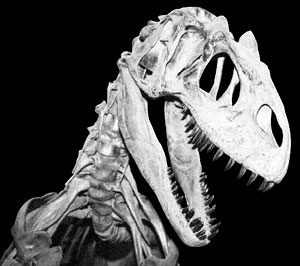
    _Allosaurus_ skull from UCMP Berkeley's site

    The authors studied the muscle scars left on the cervical vertebrae and rear skulls of every specimen. By carefully studying the location of each scar, and comparing it to the Extant Phylogenetic Bracket (EPB) – which would be birds and crocodylians – it was possible for them to determine which scar belong to which neck muscle.

    Neater still; the size of a muscle scar, at its origin, is proportional to the cross sectional area of that very muscle (at least when comparing homologous muscles).

    What does it all mean? Basically, the authors were able to deduce (with reasonable accuracy) the overall size of the muscles found in these theropod’s necks, just by measuring the size of the muscle scars left on the cervical vertebrae themselves.

    Now how cool is that?

    The end results featured 3 representative species:

    1. Tyrannosaurus rex
    2. Allosaurus fragilis
    3. Ceratosaurus nasicornis

    Each one was a “poster child” for a particular feeding method.

    _T.rex_ skull from Biocrawler dinosaur encyclopedia

    Tyrannosaurs (especially Tyrannosaurus) employed a puncture and pull method that required strong muscles for pulling the neck up and sideways (somewhat similar to the feeding method used by crocodiles when on land).

    Neoceratosaurs showed strong ventral musculature suggesting strong downward force was being used. They also show strong dorsal and lateral musculature, which suggests that they employed a “hit and run” method of attack that would be similar to white pointer sharks, or Komodo dragons.

    Last, but certainly not least, Allosaurus and its ilk were more similar to the speedy dromaeosaurs (Deinonychus, Velociraptor) in hunting style. Strong ventral musculature helps to corroborate previous studies (such as Emily Rayfield’s FEA study) that Allosaurus used its head like a hatchet, and slammed it down into prey animals. The long, strong forearms were probably used first to hold prey and brace it for the killing strike.

    All in all, this was a fascinating paper. One with the potential to change all future reconstructions of these animals.

    So keep your eyes tuned to Discovery Channel, as I’m sure they are bound to make a special that will incorporate this data (they always do).

    ~Jura


  • Of the Birds, the Bees and the Dinosaurs.

    This is actually a re-write of a previous blog post that got lost in the void of cyberspace when I clicked the “save” button.

    Needless to say, I’m not feeling as driven to write everything all over again. As such, I’m just going to touch on the highlights.

    I’ve been in internet connection hell for the past 2 weeks, so I’m a bit behind on the reptile news. This latest one comes from about a week ago.

    Study finds that dinosaurs had sex as youths.

    A study by Gregory Erickson and colleagues has found that dinosaurs did not wait until they were fully grown up, before engaging in sex.

    Though the finding is touted as a surprise, the reality is far from that. The scientists in question studied the bone microstructure of 7 theropods that were found near eggs (therefore, expected to be the parents of said eggs). These theropods were also of close relation to birds (clades: Oviraptorosauria and Deinonychosauria). What they found was that a members of each clade showed signs that they were still growing while watching their eggs.

    In the grand scheme of things, this is not surprising. Sexual maturity hits reptiles, mammals, fish and amphibians before full body size is achieved. It is often represented as a time when maximal growth rate ends (as resources get diverted to egg/sperm production).

    The only exceptions to this rule are Avians. Birds reach full adult size extremely fast (1 year, or less for most species). Sexual maturity trails way behind at 2-4 years in many of the larger animals. The reasoning behind this is due to the mechanical limitations of flight in birds. The musculature required to sustain flight, is not available in birds until they reach adult size. As flight is the main means of escape from predators, it behooves birds to reach flight status as quick as possible.

    Well, needless to say, few dinosaurs flew (Microraptor gui being the only example I can think of), so the pressure to hit adult size was just not there for dinosaurs.

    In the end this report can be filed under: Assumed and Now Validated.

    This finding, along with many other findings over the past couple of years just helps to remind us that birds evolved from dinosaurs; not the other way around.

    ———————————————————–

    Reference

    Erickson, G.M., Curry Rogers, K., Varricchio, D.J., Norell, M.A., Xu, X. 2007. Growth Patterns in Brooding Dinosaurs Reveals the Timing of Sexual Maturity in Non-Avian Dinosaurs and Genesis of the Avian Condition. Biology Letters Published Online. doi: 10.1098/rsbl.2007.0254


  • The fibrolamellar smoking gun.


    Three different types of bone growth scene in vertebrates. A. Low vascular, lamellar bone. B, highly vascular, woven bone. C. Fibrolamellar bone. Arrows indicate Lines of Arrested Growth (LAGs). Image from http://ltc.smm.org/histology/
    Three different types of bone growth seen in vertebrates. A. Low vascular, lamellar bone. B, highly vascular, woven bone. C. Fibrolamellar bone. Arrows indicate Lines of Arrested Growth (LAGs). Image from http://ltc.smm.org/histology/


    For over twenty years now it has been assumed that there is a black and white divide between bone histology and thermophysiology. Automatic endothermic “warm blooded” animals tend to show a haphazard composition of bone deposition, in which bone is laid down around surrounding blood vessels very quickly, with interspersals of more organized bone deposition (for strength). The term, coined by histologist Armand de Ricqles (1980), is fibrolamellar bone.

    In contrast, bradymetabolic “cold-blooded” animals tend to show a regular deposition of layered, or lamellar zonal bone. This bone is not as well vascularized as fibrolamellar bone, and is often deposited at a much slower rate.

    Back in 1980, this evidence was used along with a chain of other circumstantial evidence to show that dinosaurs were actually “warm-blooded” animals (Bakker, 1980). This challenge did not go unanswered, and even back then there were people questioning the evidence being proposed in favour of dinosaurian automatic endothermy. As far back as 1982, there were authours claiming to have histological evidence of fibrolamellar, “warm-blooded” bone growth in crocodylians (Ferguson et al, 1982). This evidence has often been scoffed at as being questionable at best (Horner & Padian, 2004). Skeptics have pointed out that the fibrolamellar crocodylians mentioned have all been captives. Being kept in a stable environment with easy access to food has resulted in these skewed results. Wild individuals would doubtfully show these traits, as access to scenarios like those provided in captivity, are unlikely.

    For awhile this seemed to keep the argument of fibrolamellar bone, strictly in the pro-automatic endotherm camp. Well, not anymore.

    Tumarkin-Deratzian, A.R. 2007. Fibrolamellar bone in adult Alligator mississippiensis. Journal of Herpetology. Vol. 41. No.2:341-345.

    This paper reports the observation of long bone histology in alligators from Lake Griffin in Lake County, Florida. The findings are most interesting. Seven specimens were studied. Of these, three had extensive fibrolamellar growth in their long bones. In fact, one could put a fibrolamellar individual next to a lamellar zone individual and it would look like one was comparing a “classic mammal” to a “classic reptile.” The difference is incredibly dramatic; even moreso than comparing frame A with frame C in the above picture.
    That’s not the best part though. You see, these lake Griffin alligators were not only wild animals, but they were stressed animals too. Currently the Lake Griffin alligator population is suffering from an intense die off. The reasons behind the high mortality at Lake Griffin remain uncertain, but there seems to be a link to thiamine deficiency in the animals dying.

    This means that, not only are we seeing different bone deposition patterns in animals from the same population, but we are also seeing them from animals that were living under stressed conditions. This throws the whole “crocodylians can only show automatic endothermic growth rates under perfect conditions” argument right out the window.

    So what does fibrolamellar deposition really show? Currently it remains unknown. It might still indicate faster growth. What it doesn’t indicate, though, is the thermophysiological preference of the animal in question.

    Id est: it doesn’t seperate the “warm-bloods” from the “cold-bloods.”

    More to come. Stay tuned.

    ~Jura

    References
    Bakker, R. 1980. “The Need for Endothermic Archosaurs.” In: Thomas, R. D. K., and Olson, F. C. (eds.). A Cold Look at the Warm-Blooded Dinosaurs. Westview Press, Boulder.
    de Ricqles, A. J. 1980. “Tissue structures of dinosaur bone: Functional significance and possible relation to dinosaur physiology.” In: Thomas, R. D. K., and Olson, F. C. (eds.). A Cold Look at the Warm-Blooded Dinosaurs. Westview Press, Boulder. Pp. 103-139.
    Ferguson, M.W.J., Honig, L.S., Bingas Jr, P., Slavkin, H.C. 1982. In vivo and in vitro development of first branchial arch derivatives in Alligator mississippiensis. Progress in Clinical nad Biological Research. Vol. 101: 275-286.
    Padian, K. and Horner, J.R. 2004. “Dinosaur Physiology.” In: Weishampel, D.B., Dodson, P. and Osmolska, H. (eds.), The Dinosauria 2nd edition. Univ. California Press., Berkeley. pp. 660-671.

  • When dinos were nixed, mammals stayed fixed.

    According to news from CNN.com, (though technically, AP), mammals weren’t itching to take over the newly vacated niches left behind by the dinosaurs 65 mya.

    A new phylogenetic study of mammals, reported that there was no burst of activity following the demise of the dinosaurs. There was some flurry of speciation in animals that left no descendants, but all extant mammals remained pretty low key until around 55-35 mya.

    As is typical for these studies, the results are somewhat controversial. Some folks are questioning the dating methods used, while others are both shocked and impressed with the results.

    Though the AP sticks in the hyperbolic: “…challenges a long-standing theory.” statement, I doubt we’ll be seeing textbooks getting rewritten anytime soon.

    ~Jura


  • Latest Paleo News

    Apparently these past couple of days have been a bit of a boon to paleontology. 3 new finds have just been announced.

    The most recent find, is that of a new species of gliding reptile from the early Cretaceous period (125 mya).

    See: New Scientist for a full description.

    The neat thing about this critter is that it is the oldest gliding lizard to date. Back in the Permian and Triassic periods, there were various gliding critters like Sharovipteryx, Coelurosauravus, and Kuehneosaurus. None of these reptiles were lizards, though.

    This new guy, Xianglong zhaoi, is the first true member of squamata that glided. The New Scientist illustration makes the critter look nearly exactly like a modern day Draco. I haven’t read the paper yet, so I’m not sure how accurate it is. Finally, another neat thing about this little guy (only 15 cm long) is that it was preserved so well that one can actually make out the wing membrane itself. Very cool stuff.

    The second bit of news is among the crocodyliformes. A new species of Metriorhynchid suchian has been unearthed in Eastern Oregon. Metriorhynchids were a completely marine group of crocodyliformes. They are easily diagnosed by their thin snouts with needle like teeth, their lack of any real scalation (in specimens that retain skin impressions) and the presence of a bifurcated, or forked tail. Imagine something like the horrible love child of a crocodile and a shark.

    Full story here

    According to the report, this new guy, who has yet to be named, lived around the middle to late Jurassic (180-150 mya). According to the report, this species retained short stubby limbs (all other Metriorhynchids evolved paddles), which suggests that it might have still made forays onto land. It was probably a coastal dweller. It must have been pretty clumsy on land, though, given its large forked tail.

    The last bit of news is in the realm of dinosaurs. Paleontologists have recently announced the discovery of an ornithischian dinosaur that was a burrower. The new dino, named: Oryctodromeus cubicularis, was found inside an ancient burrow. It also showed a couple of unique features that suggest this animal did the burrowing itself.

    One can read more on the story here.

    The paper will appear in the next issue of: Proceedings of the Royal Society B.

    Once I get ahold of these papers, I may make an update.

    Stay tuned.

    ~Jura