


 by
by 
For a primer on this blog series and an FAQ see here.
| Other Episodes |
||||
| Coasts | Deserts | Freshwater | Ice Worlds | Forests |
| Islands | Badlands | Swamps | Oceans | North America |
This episode features contributions from the following paleontology consultants:
- Steve Brusatte
- John Conway
- David Evans
- Alexander Farsnworth
- Scott Hartman
- John Hutchinson
- Robert Spicer
- Paul Valdes
- Mark Witton
- Darren Naish
As discussed in the associated Twitter Megathread, this episode was a bit of a hodgepodge of several clips from other episodes. So, a bit of a potpourri here.
Scene 1: Swamplands of Northeast Asia

This scene starts off as an unofficial continuation of the Quetzalcoatlus northropi egg laying scene from the Freshwater episode. This part is discussed some in the Twitter Megathread.
Baseless speculation
Growing up azhdarchid
Hatchling Q. northropi are seen leaving their island nest. To do so, the newborns must first learn to fly and cross the dangerous swamp between the island and the forest. While a neat storyline idea, we have no data on what young azhdarchids were doing during this time of their lives. This scene appears to have been mostly inspired by known observations of tiger sharks hunting fledgling albatross in some Central Pacific Islands.
Shamosuchus the sham
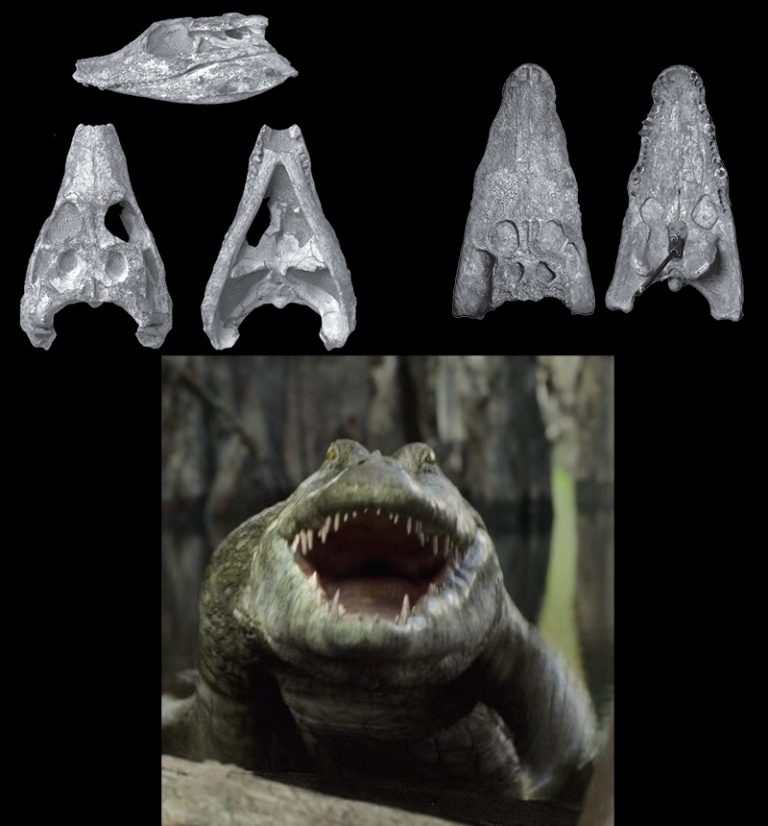
As some Q. northropi fail to make it across the lake, they are preyed upon by the paralligatorid, Shamosuchus djadochtaensis. The problem with this scene is that S. djadochtaensis is not portrayed as the correct animal. Instead, it gets this weird, poor-quality Alligator treatment that does not reflect the fossil at all. What we are treated to is one the lowest-quality animal models in the series. Not only that, but several B-roll scenes features closeups of saltwater crocodiles. Thus, PP continues the unsavoury tradition of these prehistoric fiction pieces treating all prehistoric crocodyliformes as interchangeable.
Credit to Naish in the Megathread for expressing some lament and maybe even subtle pushback against the suits at Apple over their use of B-roll and the poor naming choice here (Naish argues that Paralligator gradilifrons was closer to the original template).
That said, both paralligatorids are too old to have been present in this location during the Maastrichtian. As mentioned in the Megathread, it’s likely that some crocodyliform was patrolling these waterways. However, we currently don’t have any taxa described. The show should have gone with a more generic named “paralligatorid” and left it at that.
Also, put more effort into the non-dinosaur fauna if you’re going to do this. The quality drop is pretty drastic.
Reasonable inference…but still speculation
Quickly airborne
The young hatchlings soon take to the air a few hours after being born.
We have pretty good data to show that many pterosaur hatchlings were “flight ready” when they were born (Naish et al. 2021). That is to say that their bones show that they were capable of handling the rigours of flapping at that age. Whether they were flapping about a few hours after being born, or a few days later is harder to say.
Scene 2: Wetlands of Argentina
Baseless speculation
Solitary Austroraptor
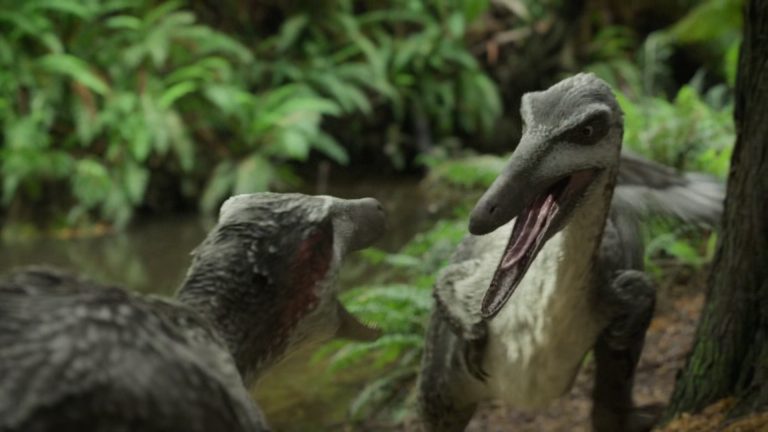
For those that have read the previous posts in this series, the fact that I’m complaining about a dromaeosaur being portrayed as solitary may look out of place. To be clear, I am very happy to see at least one dromaeosaurid buck the narrative trend of pack life. The only reason this part is getting a sin is because Attenborough outright states that Austroraptor cabazai was solitary for most of the year. That statement took the level of perceived knowledge just one step too far.
Territorial fisher
We see A. cabazai fiercely defending its fishing spot in a manner not unlike extant crocodylian species. It’s an interesting take, but one with no data backing it one way or the other.
Picky eaters
We see a juvenile A. cabazai sneak in to eat the leftovers of fish by adults. Attenborough tells the audience that the plentiful amount of fish meant that adults could afford to only eat the choicest pieces of fish. This is a very mammal-centric view that doesn’t have any real backing in extant sauropsids. Unless there is a toxic part of the fish that the animal seeks to avoid, the entire fish would more likely be eaten.
Reasonable inference…but still speculation
Fish specialist
This scene is all about A. cabazai and its fishing prowess. At one point Attenborough informs the audience that the crocodile-like teeth of A. cabazai make these dinosaurs very skilled at catching fish. The tooth comparison is apt, as Novas et al. (2009) pointed to their rather non-theropod shape in the original description. Later, Brum et al. (2021) proposed that unenlagiines as a group were piscivorous or at least incorporated more fish into their diets than typical theropods. So, this concept has some fairly solid backing in the literature, though the specifics of that fishing style and how much fish was part of the diet remain open for interpretation.
Myth promotion
Showing modern-day dragonflies and gar in this scene rather than more period-specific species (when available) continues to perpetuate the myth that these animals are unchanged “living fossils”.
Scene 3: Northern Madagascar
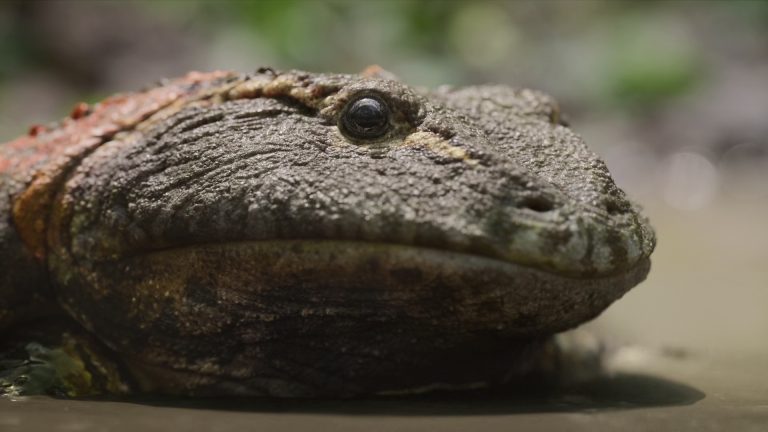
The star of this scene is the giant frog, Beelzebufo ampinga. We originally saw this species back in the Freshwater episode. This time we get a more focused story on this interesting amphibian. It focuses on a single male attempting to attract females to a small pool of water.
Baseless speculation
Mating season
Attenborough tells us that female B. ampinga only mate at the start of the rainy season. We have no data for this.
Mostly speculation
Bass-head
We are shown a male B. ampinga attempt to attract females to his location by emitting a low-frequency call. B. ampinga is related (however distantly) to extant horned frogs (Ceratophrys sp.; Evans et al. 2014), which do grow to be fairly large (e.g., 103 mm Snout Vent Length [SVL] for C. cornuta). These frogs do not produce deep bass sounds, but have more soprano-range frequencies of 1.7 kHz (Valetti et al. 2013). That doesn’t mean that B. ampinga couldn’t have done something different and aimed for a lower in the register, though. Extant Pyxicephalus species grow roughly as large as B. ampinga in SVL (Evans et al. 2014) and do produce lower calls. This one is harder to tease out as the sound-producing structures in B. ampinga are not preserved. So, it may have produced bass, or it may have been in the mid-high registers. As for the water dance…that really depends on how long B. ampinga could hold that note.
Mud bathing sauropods
Another animal in this scene is the sauropod, Rapetosaurus krausei. A herd of them stop by to bathe in mud that B. ampinga was using to call for females. One of the massive sauropods lies on its side in the mud. Attenborough informs the audience that the pool B. ampinga was using was now beneath 70 tonnes of sauropod.
We don’t have any evidence for mud bathing in sauropods (or any dinosaur) but mud baths are fairly common in a variety of animals from giant tortoises to elephants. That said, a 4-tonne elephant rolling around in mud is a very different thing from a 70-tonne dinosaur. I’m not sure that there would either be enough mud to make it worth it for these sauropods, or if an animal lying on its side in the mud could ever get up again. This is a case of applying extant behaviour to an extinct animal without considering the size and anatomical differences.
Reconstruction quality
R krausei is reconstructed with a thin, whispy tail that seems very out of place for “rear-wheel drive” animal like a sauropod. The original material indicated a rather standard sauropod tail (Rogers 2009), so it’s not like there was an anatomically-driven reason to keep the tails so thin and seemingly short. The tails should have been much thicker for their associated musculature.
Scene 4: Inland basin of North America
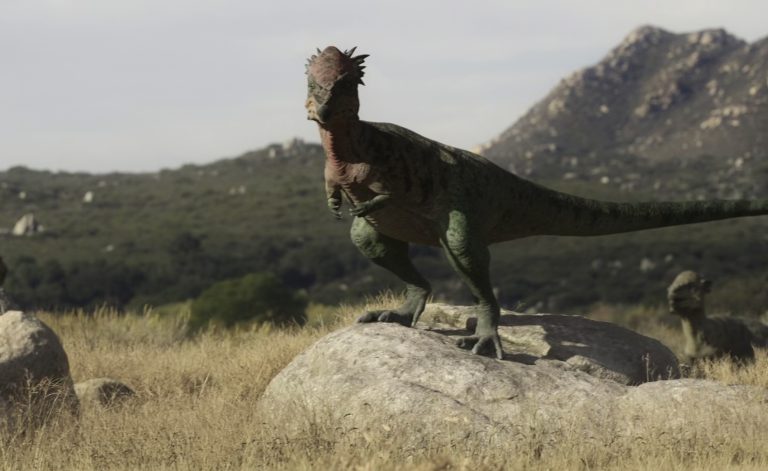
This scene takes place well away from any swamps. In the Twitter Megathread, Naish complains about the episode title choice being driven more by suits than science. As I mentioned in the beginning, this episode is more of a potpourri of scenes that didn’t fit anywhere else in the series.
Just wrong
The star of this scene is the eponymous pachycephalosaurid, Pachycephalosaurus wyomingensis. The audience is shown a herd of the animals crossing a dry grassland. The scene is all wrong for where P. wyomingensis is known (coastal marshlands). Naish points out this problem in the Megathread and how he fought to move it to an appropriate locale but was ultimately shut down by the producers. Still, wrong is wrong.
Baseless speculation
Herd living Pachycephalosaurus
As mentioned, we are shown a herd of P. wyomingensis. There is no evidence of any social interaction among any pachycephalosaur aside from inferences based on their domed heads. P. wyomingensis —as with most pachycephalosaurids—is only known from skull material (Horner and Goodwin 2009). There are no pachycephalosaurid bonebeds. The rarity of pachycephalosaurid fossils has led to proposals of a more upland habitat away from fossilization (Norman 1985, but work by Mallon and Evans 2014 contradicts this view).
Despite several studies looking at how pachycephalosaurids used their domed skulls (e.g., Snively and Cox 2008; Peterson and Vittore 2012), none of these interpretations of skull dome use requires herd living. If the domes were used to fend off sexual rivals then an occasional meeting during the year would be enough to suffice.
Alpha male leads the herd
Given that the initial premise (herd living) is not based on anything, one would imagine that this type of social makeup is also made up. Naish touches on this a bit in the Megathread, relying heavily on relationships to ceratopsians as a means to justify herd living. Not that it does anything to help the alpha male part.
Petulant young male is ejected from the herd
A young upstart attempts to flex his might and ultimately gets shoved out of the herd. The entire scene is made up with no basis in the fossils nor their relatives.
Extra sin here for having the other members of the herd looking forlorn at the ostracizing. That’s some Disney-level garbage there.
Mostly speculation
Knocking over trees with their domed skulls
The audience is shown a scene wherein a P. wyomingensis knocks over a dying tree to get access to the insects living under it. The animal uses its reinforced skull to do the damage. Although we don’t have any evidence that this happened, we do have good modeling data to indicate that a version of this could happen. It’s even a relatively reasonable assumption given the lack of food around the (out of place) area that the animals are in.
Intimidation rather than direct confrontation
Before the big shoving match begins, both males are shown intimidating one another with snorts and stereotypical head movements. Despite a lack of evidence for any of this, behaviours such as these are common to most animals in social interactions as the cost of a fight is much higher in wild animals. The specifics of what those intimidation behaviours would have looked like remain unknown.
As for the shoving match, it is largely based on real hypotheses (e.g., Carpenter 1997). So, no real issues there.
Reconstruction quality
Tails too thing again
The tails of P. wyomingensis are portrayed as quickly thinning rails. In the Megathread, Naish discusses the difficulties associated with reconstructing the tail anatomy. Despite being known mostly from bits of skull dome we do have some species that preserve enough of the postcrania to have a good idea of what a “typical” pacycephalosaurid looked like. This includes the tail, which is unique in having mineralized intermuscular septa running through it (Brown and Russell 2012). These myorhabdoi offer a glimpse at the arrangement of the intrinsic tail musculature. If one goes strictly by the location of these mineralized myorhabdoi then one could be mislead into thinking the tails were relatively thin. However, these intermuscular septa only tell us about the placement of the muscles, not their size. Muscle size will be independent of this. Further, these myorhabdoi do not account for the large caudofemoralis muscles that would be driving the legs (Brown and Russell 2012). Postmortem shrinkage of the muscles (due to water loss and rot) wouldn’t affect the location of these myorhabdoi, but would reduce the thickness of the tail.
To summarize: the tails are too thin and show no interaction with the hindlimbs. I’m giving this one double sins as the too thin tail thing has been a recurring theme for Prehistoric Planet.
Scene 5: Swampy North America

Baseless speculation
Herd living Triceratops…again!
As discussed in the Forests episode, we have more evidence to support Triceratops being solitary rather than social.
A pair of Tyrannosaurus
The stars of this scene are two Tyrannosaurus rex brothers that go on a hunt together. As discussed in the Islands episode, we have paltry evidence for gregariousness in some tyrannosaurids. We have zero evidence for pack hunting, much less this extended familial bonding thing that is going on here. Prehistoric Planet is treating T. rex like a lion or cheetah rather than a dinosaur. In the Megathread, Naish admits that the brothers angle was specifically done to push this familial bonds idea. There is no evidence to support such a mammal-centric way of thinking.
I don’t normally do a double sin for something ancillary to the main production, but using a “documentary” to push a data-poor pet hypothesis earns it.
Setting a trap
The T. rex brothers set an ambush for their prey. This ambush involves one of them making noise to scare an Edmontosaurus annectens and get it to run towards the other brother. This is a very sophisticated, lion-centric setup with no data to support it. At this point the whole trap setup has become a trope for these dinosaur “documentaries”.
Mostly speculation
Speedy Edmontosaurus
During this scene Attenborough states that E. annectens would run twice as fast as T. rex. Interestingly, we have surprisingly solid data on what the top (or near top) speed of T. rex is (Hutchinson 2001; Hutchinson et al. 2007). There are fewer studies on “top speed” in hadrosaurs (Sellers et al. 2009; Persons and Currie ) and estimated highest realistic speeds were only slightly higher than that proposed for the top speed of T. rex. So, twice as fast may be a bit too much, but faster is still likely. Prey are often faster than their predators, which is why so many predators rely on faster acceleration and ambush.
I’ll note that Naish does mention that this twice as fast statement was an error.
Reasonable inference…but still speculation
The superior night vision of Tyrannosaurus
We are shown the T. rex brothers hunting at night. Support for this comes from the large orbit of T. rex and inferences of scleral ring morphology from other tyrannosaurs that would seem to indicate a cathemeral lifestyle similar to extant crocodylians and big cats. I would consider this a plausible scenario. So, no sin there.
What does warrant a sin, though, is Attenborough’s statement that T. rex had the largest eyes of any dinosaur and that it gave them superior low-light vision. Whereas we can reasonably infer that T. rex was active at night, the degree of low-light sensitivity is out of reach for current paleontology. Big eyes are important and at 142 mm in orbit length (Lautenschlager et al. 2024), T. rex likely had large eyes (note that the orbit is the bone surrounding the eyeball and thus has to be larger than the eye). However, assessing visual acuity here would require knowledge of the distribution of photoreceptive rods and cones within the retina and how these structures change with increasing eye size (Lautenschlager et al. 2024).
Lastly, though T. rex had large eyes, they were far from the largest eyes of any dinosaur. Several hadrosaurs, including Edmontosaurus, had larger eyes than T. rex, with Shantungosaurus giganteus holding the current record for largest eyes based on an orbit length of 185 mm (Lautenschlager et al. 2024).
Final sin count: 26
References
Naish, D., Witton, M.P. and Martin-Silverstone, E., 2021. Powered flight in hatchling pterosaurs: evidence from wing form and bone strength. Scientific Reports, 11(1), p.13130.
by